
Sleep and Memory: What Happens to the Brain While We Sleep?
- Oct 6, 2025
- 4 min read

Sleep and Memory: What Happens to the Brain While We Sleep?
Sleeping isn't just about resting. During sleep, the brain engages in a veritable marathon of silent and essential activities—especially when it comes to memory and learning . As counterintuitive as it may seem, much of what we learn during the day is only truly consolidated while we sleep .
The neuroscience of sleep has revealed that, far from being a passive state, sleep is an active phase of brain processing , where memories are organized, information is filtered, emotions are regulated and even solutions to problems can emerge.
In this article, you'll understand what really happens in the brain while we sleep—and why it directly impacts your ability to learn, remember, and grow intellectually.
Sleep: A Cycle, Not an Off Switch
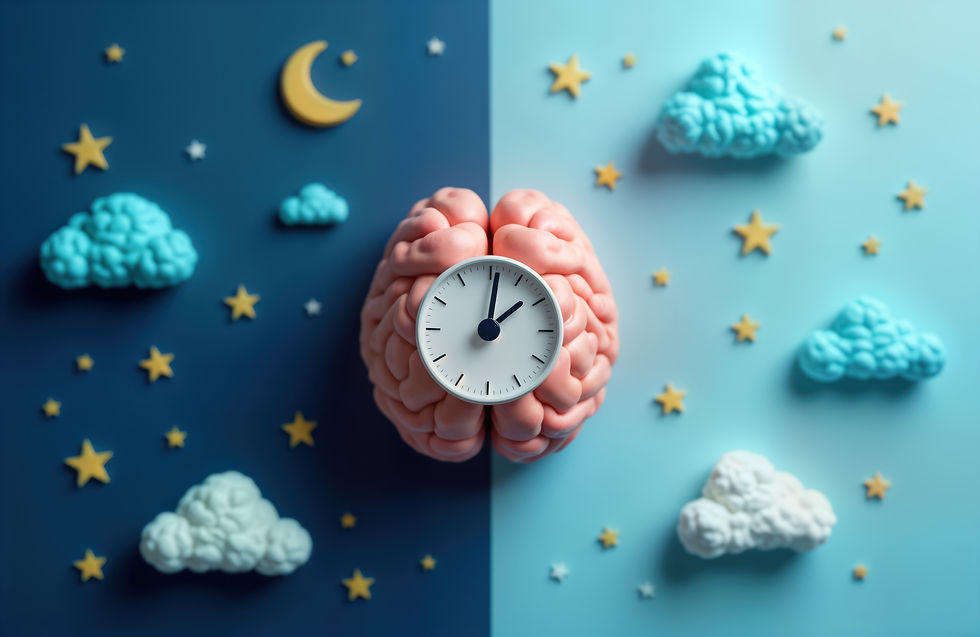
Sleep is divided into cycles that repeat throughout the night, typically lasting an average of 90 minutes. Each cycle is composed of different stages , each with specific functions in the brain:
Stage 1 and 2 (light sleep) : transition between wakefulness and deep sleep.
Stage 3 (deep or slow-wave sleep) : physical restoration, release of hormones, consolidation of factual memories.
REM (rapid eye movement) : vivid dreams, consolidation of emotional memories and creativity.
It is during deep sleep and REM that the main activities related to memory and information processing occur.
How does sleep consolidate memory?
Memory goes through three major stages:
Encoding - happens while we are awake, paying attention to something new.
Storage - occurs while we sleep, when the brain decides what to keep.
Recall - happens when we need to remember, often days or weeks later.
During sleep:

The hippocampus (a key region for short-term memory) “relays” information to the neocortex , where it is stored long-term.
Slow brain waves synchronized with sleep spindles facilitate this transfer.
Irrelevant or noisy information is discarded, preserving what is meaningful.
In simple terms: sleeping is like backing up what matters and deleting what you don't need.
Sleep and learning: is sleeping studying?
It's no exaggeration to say that sleep is part of the learning process . Several studies show that people who sleep well after studying:
They retain content better,
They make fewer mistakes,
They find it easier to understand the context and apply knowledge.
Research from Harvard University has shown that taking a 60- to 90-minute nap after studying can improve performance on memory tests even more than continuing to study without a break.
More than a break, sleep is an active moment to strengthen learning.
Emotions, dreams and emotional memory
Sleep also plays an essential role in emotional regulation . During REM sleep, the brain processes intense emotional experiences—such as trauma, stress, loss, or conflict.
Dreams with symbolic content help to “digest” these emotions,
The activity of the prefrontal cortex (emotional regulator) is activated, while that of the amygdala (fear response) is reduced,
This allows you to reinterpret difficult events with more balance .
For this reason, sleepless nights can make people more irritable, impulsive and emotionally unstable.
Fun Fact: Can the brain solve problems while sleeping?

Yes, and this is more common than you might think.
Historical accounts of scientists, musicians, and inventors indicate that creative solutions emerged during sleep . Paul McCartney claimed to have "dreamed" the melody of " Yesterday ." Chemist August Kekulé dreamed of snakes forming a circle and came up with the idea for the structure of benzene.
Today we know that REM sleep:
It stimulates unusual associations ,
Activates neural networks of creativity ,
It allows access to “hidden” information that does not emerge in linear logical thinking.
Sleep deprivation: what happens to memory?
Sleeping poorly affects memory directly and profoundly:
Reduces the ability to concentrate and learn,
Interferes with the consolidation of newly acquired memories,
It increases the risk of errors and forgetfulness,
Creates fragmented or distorted memories.
In the long term, chronic sleep deprivation is associated with an increased risk of dementia and neurodegenerative diseases such as Alzheimer's.
Sleep, technology and distraction: the new villain
With the constant presence of screens, notifications, and digital stimuli, sleep has become one of the first victims of hyperconnectivity. The blue light from devices inhibits the release of melatonin , the hormone that signals the body to sleep.
Furthermore, excessive stimulation before bedtime impairs the natural transition to deep sleep , which directly affects the quality of memory consolidation.
Practical Science Tip:
Avoiding screens at least 1 hour before bed can significantly improve sleep efficiency and cognitive performance the next day.
Sleep hygiene for a sharper mind

You don't have to rely solely on genetics or coffee to have a good memory. The quality of your sleep is one of your mind's greatest allies. Here are some scientifically proven habits that help:
Maintain a regular bedtime and wake-up time;
Create a dark and quiet environment;
Avoid heavy meals at night;
Practice physical activities (but not close to bedtime);
Reduce caffeine and alcohol consumption;
Replace nighttime screen time with light reading or meditation.


Comments